

The Unknown Debussy: Seduction, Obsession, and Abandonment at the Piano
Nicolas Horvath and Robert Orledge unearth the ghosts Debussy tried to bury
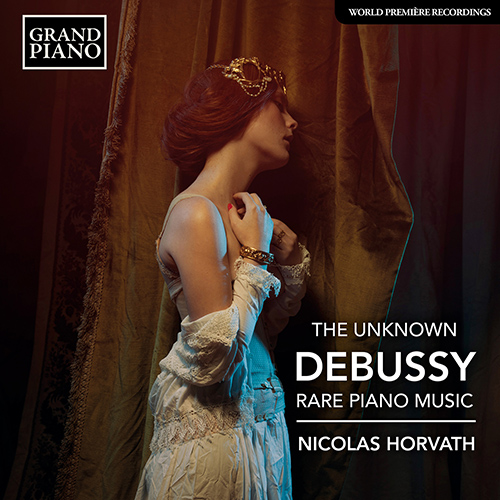
The Unknown Debussy: Rare Piano Music (Grand Piano GP822)
As far as women were concerned, Claude Debussy was a bastard. As far as finishing things was concerned — operas, ballets, theatrical projects of every description — he was something considerably worse: a compulsive seducer of ideas who courted them passionately, possessed them briefly, and then walked away, leaving behind a trail of sketches, drafts, and broken promises that would take a century to sort out. More than fifty theatrical projects were conceived during his lifetime. He completed exactly two.
It falls to pianist Nicolas Horvath and the British musicologist Robert Orledge — arguably the world’s foremost authority on Debussy’s abandoned works — to give us this extraordinary album of première recordings. Played on a gorgeous 1925 Steinway Model C, The Unknown Debussy is nothing less than an archaeological excavation of a genius who could not stop starting things, conducted by a scholar who could not stop finishing them. And the story behind every track is at least as gripping as the music itself.
🎵 Listen: The Unknown Debussy — Full album on Naxos Music Library
The Prodigal Son and His Older Woman
The album opens with the Prélude to L’enfant prodigue, the 1884 cantata that won Debussy the Prix de Rome at the age of twenty-two. He later dismissed it as “theatrical, amateurish, and boring” — which, given that it earned him a funded residency at the Villa Medici, seems a touch ungrateful. But Debussy was never one for gratitude, least of all towards the people and works that had served their purpose.
What the biographical record does not always emphasise is that the young man who composed this competent, prize-winning cantata had only recently emerged from an eight-year entanglement with Marie-Blanche Vasnier, the wife of a Parisian building contractor. She was beautiful, eleven years his senior, and a gifted amateur singer. He had been employed as an accompanist for her vocal lessons. She schooled the eighteen-year-old composer in the art of love — while her husband, one presumes, attended to his blueprints.
“To Madame Vasnier, these melodies, conceived in a way by your memory, can only belong to you, as the author belongs to you.”
— Debussy, dedication on early songs for Marie-Blanche
The Prélude to L’enfant prodigue, rendered here in Orledge’s piano reduction, sounds exactly like what it is: a young man trying desperately to impress his elders while his mind is clearly elsewhere. Horvath plays it with just the right balance of formal ambition and barely concealed restlessness.
🎵 Listen: L’enfant prodigue: Prélude — Spotify
The Opera He Claimed to Have Burned
Track two takes us deeper into the wreckage. The Prélude to Rodrigue et Chimène (1890–93) comes from the opera Debussy accepted from the poet and Wagner enthusiast Catulle Mendès — a man whose own wife, the writer Judith Gautier, had conducted a well-documented affair with Richard Wagner himself. The ironies pile up like unpaid debts.
Mendès had promised Debussy a performance at the Paris Opéra, and the young composer, eager to please his father and desperate for recognition, accepted a libretto he privately despised. It was, as one critic put it, stuffed with “howlers and lusty choruses of soldiers calling for wine” — the very kind of bombastic Wagnerian fare that Debussy was rapidly outgrowing. His friend Eric Satie had it right when he called for “a music of our own — preferably without sauerkraut.”
“My life is hardship and misery thanks to this opera. Everything about it is wrong for me.”
— Debussy, letter of January 1892
On 17 May 1893, Debussy attended a performance of Maeterlinck’s Symbolist play Pelléas et Mélisande and knew instantly that this was the drama he had been searching for. He abandoned Rodrigue and later claimed — with the casual mendacity that characterised his personal life — that he had accidentally burned the score. He hadn’t. The manuscripts survived, passed through the hands of the legendary pianist Alfred Cortot, and were eventually assembled by the American collector Robert Owen Lehman.
What Horvath plays here, in Orledge’s piano arrangement, is a ghost that refused cremation. And in its shifting harmonies — already unmistakably Debussy despite the Wagnerian costume — you can hear the future composer of Pelléas struggling to free himself from the sauerkraut.
Sleeping with Edgar Allan Poe
The album’s final act belongs to Debussy’s lifelong obsession with Edgar Allan Poe — an obsession that consumed fifteen years and produced two unfinished operas, a contract with the Metropolitan Opera in New York, and precisely zero completed scores.
La Chute de la Maison Usher (Track 16) and Un jour affreux avec le Diable dans le Beffroi (Track 15) represent the twin poles of Debussy’s Poe fixation: one a work of suffocating Gothic horror, the other a comic satire about a devil who makes a church clock strike thirteen. He had intended them as a double bill for the Met, having signed the contract in 1908. He never delivered.
“I have let myself stray and have almost only been working on Roderick Usher and the devil in the belfry. I fall asleep with them and find on waking the gloomy melancholy of the one or the derisive laughter of the other.”
— Debussy to his publisher Jacques Durand, 21 September 1909
The Usher story is compelling enough on its own gothic terms, but Debussy made it considerably more interesting. His own libretto — he wrote three versions — deliberately amplified what Poe had left submerged: Roderick Usher’s incestuous desire for his twin sister Madeline. The doctor, a minor figure in Poe’s tale, was elevated into a sinister rival for her affections. And as Debussy’s own health deteriorated — colon cancer, diagnosed only in 1915 after years of agonising symptoms managed with morphine and cocaine — he began to identify with his doomed protagonist. As Orledge has written, “Debussy began increasingly to identify with Roderick Usher, whose mental breakdown Poe had identified with the crumbling House itself.”
Horvath’s piano reduction, with a cadenza he composed himself, distills this dark opera into six and a half minutes of claustrophobic intensity. Madeline’s bloody hands, her dress soaked in blood as she emerges from the tomb — you can hear it all in the piano’s lowest registers, played on that ancient Steinway with its own century of accumulated ghosts.
Saints, Sinners, and Sébastien’s Beautiful Body
No account of Debussy’s abandoned projects would be complete without the delicious scandal of Le Martyre de Saint Sébastien (Track 9). In 1911, the Italian poet Gabriele d’Annunzio commissioned Debussy to write incidental music for a five-act mystery play about the martyrdom of the beautiful young Roman saint. The title role was taken by Ida Rubinstein — the openly bisexual Russian dancer who had already scandalised Paris by appearing virtually naked as Cleopatra with the Ballets Russes.
A Jewish woman playing a Christian saint in a five-hour French-language spectacle dripping with homoerotic ecstasy was, predictably, more than the Catholic establishment could stomach. The Archbishop of Paris, Cardinal Amette, publicly condemned the production and forbade the faithful from attending. The ban had precisely the effect you would expect: everyone wanted tickets.
What we hear on this album is an unused first draft of “La Passion” from Act III — music that Debussy composed while his own body was failing, sustained by what he described to a friend as “a variety of tranquillisers — morphine, cocaine, and other such lovely drugs.” The contrast between the ecstatic, almost erotic mysticism of the music and the physical wreckage of the man who wrote it is, frankly, heartbreaking.
The Man Who Finishes Debussy’s Sentences
Nearly every track on this album bears the hand of Robert Orledge, who took early retirement from the University of Liverpool in 2004 specifically to devote himself to what he calls “creative musicology” — the art of completing what the dead left unfinished. He began with the missing sections of La Chute de la Maison Usher in 2001 and has since worked his way through virtually every abandoned Debussy project that left enough sketches to make reconstruction possible.
The results, by all accounts, are uncanny. Debussy specialists have been unable to identify exactly where Orledge takes over from the composer — and vice versa. This is not pastiche; it is something closer to channelling. As Horvath has noted, Orledge “never insisted or tried to impose his own vision” — he simply listened to what the sketches were trying to say and helped them finish speaking.
The album also includes treasures that require no completion at all: a 46-second fragment of La Fille aux cheveux de lin in B-flat major (not the familiar G-flat), a first version of Bruyères from 1912, and the enchanting Petite valse — works that survived in Debussy’s papers like pressed flowers in the pages of a book no one had opened for a century.
A Recording for the Ages
Horvath, known for marathon concerts lasting twelve hours or more (he once performed the complete piano works of Erik Satie overnight at the Paris Philharmonie before a cumulative audience of 14,000), brings precisely the right combination of stamina, sensitivity, and fearlessness to this material. He is not trying to make these works sound like finished masterpieces. He is trying to make them sound like what they are: the secret diary of a man who could never stop falling in love — with women, with ideas, with sounds — and who could never quite bring himself to stay.
Which brings us back, inevitably, to the women. Gaby Dupont attempted suicide when he left her. Rosalie “Lilly” Texier, his first wife, shot herself in the chest at the Place de la Concorde when he abandoned her for Emma Bardac. The Scottish soprano Mary Garden observed with surgical precision: “I honestly don’t know if Debussy ever loved anybody really. He loved his music — and perhaps himself.”
This album, then, is the sound of what remains when genius and narcissism occupy the same body: fragments of extraordinary beauty, abandoned at various stages of undress, now lovingly reassembled by hands steadier and more faithful than Debussy’s own. It is altogether fascinating.
The Unknown Debussy: Rare Piano Music
Nicolas Horvath (piano) · Florient Azoulay (narrator)
Grand Piano GP822 · Released March 2020
Naxos Music Library | Spotify | Grand Piano Records | Bandcamp (24-bit)
Further Reading on Interlude
- Debussy’s Wives: Rosalie Texier and Emma Bardac
- Debussy’s Love Affairs and Friendships with Artists
- Gloomy Melancholy and Mocking Laughter: Debussy and Poe
- How Debussy Tried Escaping the Wagner Influence
- Tuneful Takedowns: Dissonance Aimed at Debussy
- The Agonizing Death and Final Days of Claude Debussy
- How These Great Composers Won the Prix de Rome
- Minors of the Majors: Debussy’s L’enfant prodigue
- Debussy and Baudelaire: Harmonie du Soir
For more articles by Georg Predota, visit his contributor page.
Interview source: In Search of Forgotten Debussy, Serenade Magazine (2020)